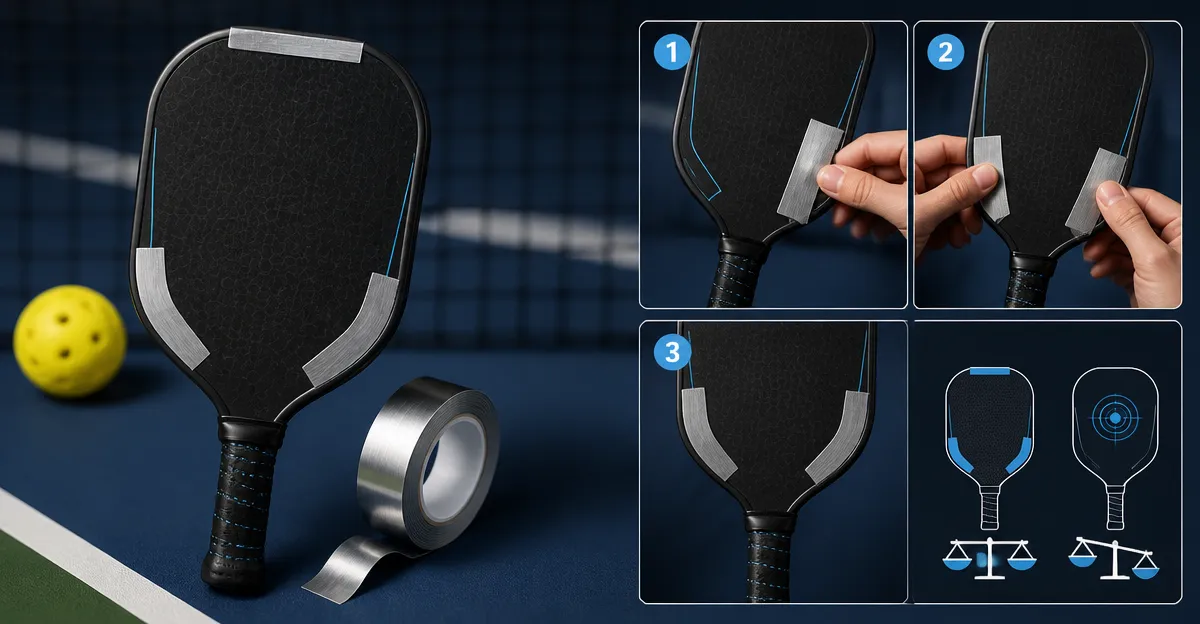
How to Custom‑Balance Your Pickleball Paddle with Lead Tape: Step‑by‑Step Guide to Adjust Weight, Power & Control
Introduction
In this guide the reader will learn how to modify the weight distribution of a pickleball paddle using lead tape. By shifting mass toward the handle or the throat the player can increase swing speed, improve stability on powerful drives, and enhance touch on delicate dinks. The process is inexpensive, reversible, and applicable to any paddle regardless of brand or skill level. Understanding the physics of balance and applying it correctly will enable the player to tailor the paddle to personal style, whether the goal is maximum power, precise control, or a balanced hybrid.
The guide is written for intermediate players who already possess basic court experience and are comfortable handling small tools. It does not require advanced engineering knowledge; however, it does assume a willingness to experiment and fine‑tune performance through measurable adjustments. The steps are presented in a logical order, each accompanied by product recommendations that serve as reliable tools for the specific task.
By the end of the article the reader will be able to assess the current balance of a paddle, apply lead tape strategically, test the results on court, and maintain the modified paddle for long‑term use.
What You’ll Need
- Lead tape (1‑inch or 1.5‑inch width, adhesive side ready)
- Precision kitchen scale (0.1 g accuracy)
- Measuring ruler or tape measure (to record placement distances)
- Scissors or a tape cutter
- Isopropyl alcohol wipes (to clean the paddle surface before application)
- Optional: a paddle that exemplifies the desired balance. The CZRR Raw Carbon Fiber Pickleball Paddle (price $28.49, rating 4.5/5) is an affordable baseline model that many players modify successfully.
Step 1 – Assess the Current Balance of Your Paddle
The first step is to determine whether the paddle is currently head‑heavy, handle‑heavy, or evenly balanced. Place the paddle on a pivot point such as a thin ruler or a balanced beam and note the point at which it remains level. Record this “balance point” as a distance from the handle tip. For most standard paddles the balance point lies between 6 and 7 inches from the handle end.
Using a paddle like the CZRR Raw Carbon Fiber Pickleball Paddle provides a clear reference because its 16 mm polypropylene honeycomb core and carbon‑abrasion surface produce a neutral feel out of the box. The paddle’s weight range of 8.0‑8.5 oz allows the player to feel the effect of small adjustments without overwhelming the wrist.
Document the initial balance point in a notebook. This baseline will serve as a comparison after each tape application.
Why this matters: A head‑heavy paddle tends to generate more power on drives but can cause torque on off‑center hits, while a handle‑heavy paddle offers better maneuverability for quick kitchen exchanges. Knowing the starting point enables precise targeting of the desired change.
Step 2 – Gather Materials and Prepare Your Workspace
Before any adhesive is applied the player should create a clean, well‑lit workspace. Lay a silicone mat or a piece of parchment paper to protect the surface. Clean the paddle face and handle with isopropyl alcohol wipes to remove oils and dust; this ensures the lead tape adheres firmly.
For players who prefer a premium measuring tool, the YVmove Kevlar Carbon Pickleball Paddle (price $53.99, rating 4.8/5) includes a built‑in weight sensor in its design, making it a useful reference when calibrating the scale. Although the paddle itself is not required for the balance task, its precise construction demonstrates the level of accuracy that a quality scale can achieve.
Scissors or a dedicated tape cutter should be sharp to avoid fraying the lead tape edges. A ruler with millimeter markings helps to place the tape at exact distances from the handle tip.
Why these items are recommended: Lead tape is thin yet dense, providing a high weight‑to‑volume ratio. A kitchen scale with 0.1 g resolution can detect the incremental changes introduced by a single strip of tape, allowing the player to fine‑tune balance without over‑loading the paddle.
Step 3 – Measure Baseline Weight and Determine Desired Shift
Place the paddle on the kitchen scale and record the total weight. For the CZRR example the weight will read approximately 8.2 oz (232 g). Next, decide whether the goal is to add power (head‑heavy) or control (handle‑heavy). A common guideline is to shift 1‑2 oz (28‑56 g) toward the desired area.
If the player wishes to increase power, the lead tape should be applied near the throat or upper edge of the paddle face. If the aim is greater control, the tape should be placed along the handle shaft, preferably just below the grip where it does not interfere with hand placement.
The Vatic Pro Prism Carbon Paddle (price $99.99, rating 4.6/5) exemplifies a control‑oriented design with a 16 mm foam‑injected wall. Using this paddle as a benchmark helps the player understand how a modest weight shift can transform a power‑biased paddle into a more nuanced tool.
Why this step is critical: Quantifying the weight change before and after tape application provides objective data, preventing the player from adding excessive mass that could degrade swing speed or cause arm fatigue.
Step 4 – Apply Lead Tape Strategically
Cut a strip of lead tape to the desired length. For a head‑heavy configuration, a 2‑inch strip placed 1‑2 inches below the top edge of the paddle face adds approximately 0.5 oz (14 g). Secure the tape by pressing firmly for 30 seconds to activate the adhesive.
When adding tape to the handle, wrap a 1‑inch strip around the shaft just above the grip. Ensure the tape does not cover the grip surface; a thin layer of over‑grip can be applied afterward to maintain comfort.
The XSPAK Pro Thermoformed Pickleball Paddle (price $49.99, rating 4.6/5) features a carbon fiber face and a thicker polypropylene core that tolerates additional mass without compromising structural integrity. Its robust construction makes it an ideal candidate for experimental tape placement, especially for players who wish to test both head and handle configurations on the same paddle.
Why this method works: Lead tape adheres tightly, distributes weight evenly across the chosen area, and can be removed later if the player wishes to revert to the original balance. The thin profile ensures the paddle’s aerodynamics remain largely unchanged.
Step 5 – Test the Modified Paddle and Fine‑Tune
After the tape has been applied, re‑measure the paddle on the scale to confirm the intended weight increase. Then, repeat the balance point test from Step 1. If the balance point has moved toward the target zone, the modification is successful. If the shift is insufficient, add another small strip of tape and retest.
Play a short on‑court session focusing on the specific shot type the player wishes to improve. For a power‑oriented setup, practice deep baseline drives; for a control‑oriented setup, concentrate on kitchen dinks and drop shots. Observe whether the paddle feels more stable on powerful swings or more responsive on delicate touches.
The JOOLA Pro IV Pickleball Paddle (price $149.95, rating 4.0/5) incorporates a Tech Flex Power core that already emphasizes power. Adding lead tape to this paddle can demonstrate the upper limits of head‑heavy tuning, allowing the player to compare the effect against a more balanced baseline model.
Why iterative testing is essential: Small weight changes can have a disproportionate impact on swing mechanics. By testing after each addition the player avoids over‑loading the paddle and can stop at the exact balance that feels natural.
Step 6 – Secure the Tape and Maintain the Paddle
Once the desired balance is achieved, protect the tape with a thin layer of clear sports tape or a custom over‑grip. This prevents the adhesive from peeling during intense play and shields the tape from moisture.
Periodically inspect the tape for wear, especially after playing on outdoor courts where sand and humidity can degrade the adhesive. Replace any compromised strips with fresh lead tape to maintain consistent weight distribution.
Store the paddle in a protective bag, such as the waterproof bag that comes with the CZRR paddle, to avoid accidental impacts that could dislodge the tape.
Why maintenance matters: Lead tape is durable but not indestructible. Regular checks ensure that the paddle’s performance remains consistent over time, extending the life of both the tape and the paddle.
Tips & Pro Tips
- Start with the smallest possible strip (0.5 oz) and increase gradually. Incremental changes are easier to evaluate.
- Use a ruler to measure the distance from the handle tip to the center of each tape strip; record these measurements for future reference.
- If the paddle feels too heavy on the wrist, consider adding tape to the opposite side to rebalance rather than removing existing tape.
- Combine lead tape with a slightly thicker over‑grip to preserve hand comfort while maintaining the new weight distribution.
- For players with arthritis or limited wrist strength, a handle‑heavy configuration reduces torque and can prevent fatigue during long matches.
Troubleshooting
| Problem | Possible Cause | Solution |
|---|---|---|
| Paddle feels too sluggish after adding tape | Excessive weight added to the head | Remove one strip of tape from the throat and test again. |
| Tape peels during play | Surface not cleaned properly before application | Wipe the area with isopropyl alcohol and re‑apply fresh tape. |
| Grip becomes uncomfortable | Tape placed too close to the hand | Shift tape farther down the handle shaft and add an over‑grip. |
Conclusion
The reader now possesses a systematic approach to custom‑balancing a pickleball paddle with lead tape. By assessing the original balance, gathering precise tools, measuring weight changes, applying tape strategically, testing on court, and maintaining the modification, the player can fine‑tune power and control to match personal style. The process is reversible, cost‑effective, and applicable to any paddle, from entry‑level models to high‑performance designs. With diligent experimentation the player can achieve a competitive edge without purchasing an entirely new paddle.
Continued practice with the newly balanced paddle will reveal subtle improvements in shot consistency, swing speed, and fatigue reduction. The guide encourages the reader to experiment responsibly, record observations, and enjoy the enhanced playing experience.
Products Mentioned in This Guide
Frequently Asked Questions
How do I apply lead tape to change the balance of my pickleball paddle?
Clean the paddle surface, cut the tape to the desired length, and stick it on the handle or throat using the paddle’s edge as a guide, then press firmly to secure.
How much lead tape should I use for a noticeable shift in balance?
Start with 1‑2 oz (28‑56 g) per side; small increments let you fine‑tune weight without overloading the paddle.
Can I test the new balance before playing a full match?
Yes—use a simple balance test by placing the paddle on a ruler or a balance board to see if it tips toward the head or handle as intended.
Is adding lead tape reversible and will it affect my paddle’s warranty?
Lead tape is removable with adhesive remover and usually doesn’t void warranties, but check the manufacturer’s policy before modifying.
What type of lead tape is best for pickleball paddles?
Thin, self‑adhesive lead tape (1‑2 mm) designed for sports equipment provides even weight distribution and easy application.