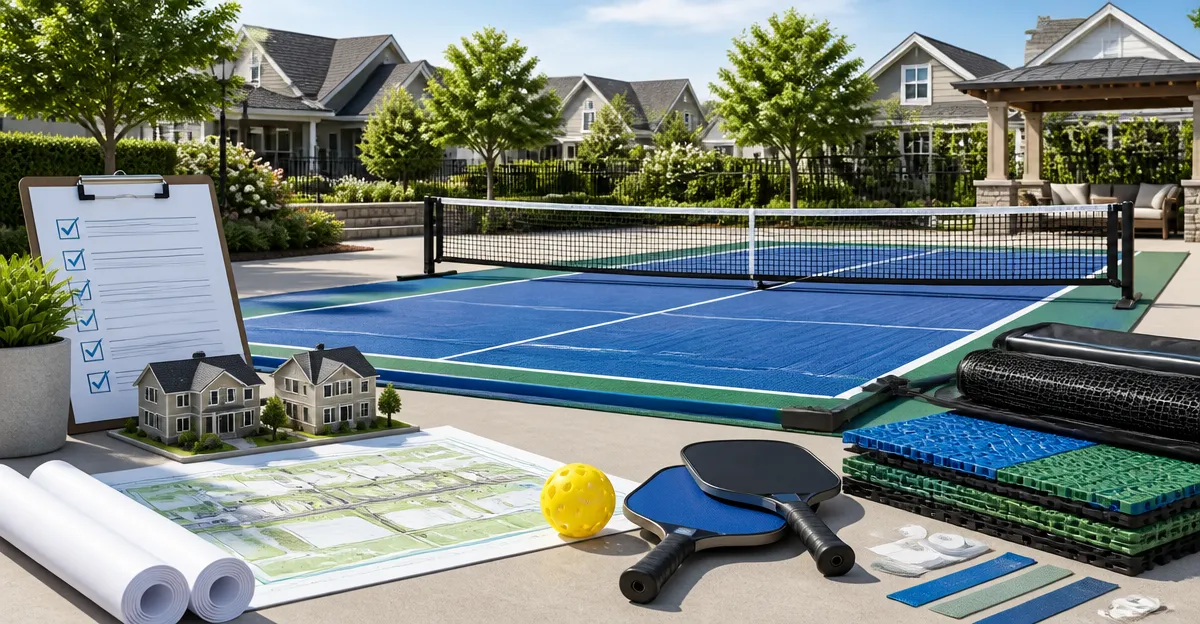
The Complete Guide to HOA-Compliant Portable Pickleball Court Solutions: Planning, Permits, and Top Products
Introduction
Homeowners associations (HOAs) often impose strict guidelines on modifications to common areas, landscaping, and temporary structures. As pickleball continues to grow in popularity, many residents seek portable court solutions that satisfy both their enthusiasm for the sport and the regulatory framework of their community. This guide explains how to navigate HOA rules, obtain necessary permits, and select the best portable equipment for a compliant and enjoyable playing experience.
Readers will learn the fundamentals of court dimensions, the permitting process, strategies for presenting proposals to board members, and a curated selection of top‑rated products that meet official standards while remaining easy to install and store. By the end of the article, one will possess a clear roadmap from concept to fully functional, HOA‑approved pickleball space.
Background and Context
Pickleball combines elements of tennis, badminton, and ping‑pong, and is played on a court measuring 20 feet wide by 44 feet long for doubles. The net height is 36 inches at the sidelines and 34 inches at the center. These dimensions are mandated by the USA Pickleball Association (USAPA) and form the baseline for any compliant court, portable or permanent.
HOAs typically regulate: (1) permanent alterations to shared property, (2) the visual impact of structures, (3) safety considerations such as trip hazards, and (4) noise or traffic generated by community activities. Understanding these concerns helps homeowners frame their proposals in a manner that emphasizes minimal disruption, safety, and aesthetic harmony.
Most portable solutions consist of a net system, optional paddles and balls, and court‑marking accessories. The net must be regulation size, weather‑resistant, and capable of quick assembly without permanent anchors. Court‑marking kits, especially magnetic or tape‑based systems, provide the lines required for official play while remaining removable.
Planning Your Portable Court
Effective planning begins with a site assessment. Identify a flat surface—such as a driveway, backyard, or community park—where the net can be anchored safely. Verify that the area provides at least 30 feet of clearance behind the baseline to prevent interference with neighboring properties.
Next, develop a visual mock‑up. Use graph paper or a simple digital layout to illustrate how the net, lines, and surrounding equipment will occupy the space. Include dimensions, storage location for the net bag, and any weight‑blocking accessories that will keep the net stable in wind.
Finally, prepare a concise written proposal for the HOA board. Highlight the following points:
- Compliance with USAPA court dimensions.
- Temporary nature of the installation and easy removal after each use.
- Safety measures such as non‑slip base pads and weighted anchors.
- Minimal visual impact due to compact storage bags.
- Benefits to the community, including increased recreation options and property value.
Permitting and Approval Process
Many HOAs require a formal permit application for any structure that occupies public or shared space, even if it is portable. The typical steps are:
- Submit a written request to the HOA board, attaching the site plan and product specifications.
- Obtain a site‑inspection appointment, allowing the board or a designated inspector to verify that the proposed setup does not violate setbacks or safety codes.
- Address feedback by adjusting placement, adding weight blocks, or selecting a net with a lower wind profile.
- Receive written approval, often valid for a defined season (e.g., spring‑fall).
- Maintain records of the installation and removal dates for future reference.
When presenting the proposal, reference reputable products with proven durability and positive user feedback. This demonstrates due diligence and reduces perceived risk.
Choosing the Right Portable Net System
Several portable net systems dominate the market, each offering distinct advantages. The following products have been selected for their compliance with regulation dimensions, ease of assembly, and strong customer satisfaction.
Hoverphenix Pickleball Net Set
The Hoverphenix Pickleball Net Set provides a complete package: a 22‑foot regulation net, four paddles, four outdoor balls, and a carry bag. The steel frame interlocks for a five‑minute setup, and the velcro‑strap top ensures tension even in windy conditions. With a 4.6‑star rating from 463 reviews and a price of $71.99, it balances quality and affordability.
Key features include:
- Regulation net dimensions (22 ft wide, 36 in sides, 34 in center).
- Portable steel frame with quick‑release interlocking joints.
- All‑weather paddles and balls for immediate play.
- Compact carry bag for storage in a garage or shed.
Hoverphenix 22ft Pickleball Net (2‑in‑1 Model)
The Hoverphenix 22ft Pickleball Net offers a dual‑size configuration: a full‑court 22‑ft net and an 11‑ft half‑court option. Its reinforced 15‑ply PE net and fiberglass center pole enhance stability, while the steel base resists wind uplift. Priced at $69.99 with a 4.8‑star rating from 135 reviewers, it is a strong contender for HOA‑friendly installations.
Notable specifications:
- Interlocking steel frame assembled in under five minutes.
- Adjustable tension straps to maintain proper height.
- Durable carrying bag for transport and storage.
Zdgao Pickleball Net Set
The Zdgao Pickleball Net Set emphasizes cost‑effectiveness. At $53.99 and a 4.6‑star rating from 727 reviews, it delivers a regulation net, steel frame, and a convenient bag. The 15‑ply knotless mesh and double‑stitched seams provide durability suitable for driveway or indoor gym use.
Key advantages:
- Budget‑friendly price point.
- Easy, tool‑free assembly in less than five minutes.
- Lightweight design for quick relocation.
Comparative Overview
| Product | Price | Rating | Net Size | Additional Items | Weight‑Block Options |
|---|---|---|---|---|---|
| Hoverphenix Net Set | $71.99 | 4.6/5 (463) | 22 ft | Paddles, balls, carry bag | None (relies on steel base) |
| Hoverphenix 22ft Net | $69.99 | 4.8/5 (135) | 22 ft / 11 ft | Carry bag only | Optional weighted base |
| Zdgao Net Set | $53.99 | 4.6/5 (727) | 22 ft | Carry bag only | None |
When presenting to an HOA, the inclusion of paddles and balls (as in the Hoverphenix Net Set) can demonstrate a ready‑to‑play solution, potentially easing concerns about incomplete setups.
Court‑Marking Solutions for HOA Compliance
Even a perfectly sized net requires clear boundary lines to meet official play standards. Two primary marking systems are suitable for temporary installations: magnetic lines and tape‑based kits.
Jisucute Magnetic Pickleball Court Lines
The Jisucute Magnetic Pickleball Court Lines employ a snap‑together magnetic cable that attaches to corner modules. The system includes twelve accessories, and optional weight blocks can be added to resist wind uplift. Bright yellow lines ensure visibility, and the entire kit rolls into a shoebox‑sized container for transport. Priced at $149.99 with a perfect 5‑star rating (single review), it is ideal for communities that prioritize a clean, reusable layout.
Features include:
- Quick magnetic connections for assembly under five minutes.
- Optional weight blocks for wind resistance.
- High‑visibility color for safety.
- Reusable and easy‑to‑clean design.
Franklin Sports Pickleball Court Marker Kit
The Franklin Sports Pickleball Court Marker Kit offers a low‑cost, tape‑based solution. It includes four L‑style and eight T‑style pieces, a measuring tape, and a durable, wipe‑clean material. At $19.59 and a 4.4‑star rating from 1,676 reviews, it is a practical choice for occasional use on smooth surfaces such as parking lots or basketball courts.
Advantages:
- Affordability for budget‑conscious HOAs.
- Simple installation with no tools required.
- Portable case for easy transport.
- Reusable after cleaning.
Comparison and Selection Guide
Selecting the optimal portable court solution depends on three primary criteria: budget, installation environment, and HOA preferences.
| Criteria | Best Value Net | Premium Net | Lightweight Net |
|---|---|---|---|
| Budget (< $60) | Zdgao Pickleball Net Set | — | — |
| All‑in‑One Package | — | Hoverphenix Pickleball Net Set | — |
| Dual‑Size Flexibility | — | Hoverphenix 22ft Net | — |
| Highest Customer Rating | — | Hoverphenix 22ft Net (4.8) | — |
| Best Marking System for Windy Areas | — | Jisucute Magnetic Lines | Franklin Sports Marker Kit |
For HOAs that require a complete, ready‑to‑play setup, the Hoverphenix Pickleball Net Set is the most compelling choice. If the community values flexibility between full‑court and half‑court play, the 2‑in‑1 Hoverphenix Net provides that adaptability. When cost is the primary driver, the Zdgao Net Set delivers regulation dimensions at a lower price point.
Best Practices & Tips for HOA‑Friendly Installations
- Document every step. Photograph the site before, during, and after installation to provide evidence of compliance.
- Use non‑permanent anchors. Sandbags, weighted blocks, or rubber pads keep the net stable without drilling or cement.
- Schedule play times. Coordinate with neighbors to limit noise during early morning or late evening hours.
- Maintain cleanliness. Store the net and lines in a weather‑proof bag to prevent litter and protect the community’s aesthetic.
- Provide a written handover. When the season ends, submit a removal report confirming that the area is restored to its original condition.
Frequently Asked Questions
- Do I need a permit for a portable pickleball net? Most HOAs require a written request and board approval for any structure, even temporary. Check your community’s bylaws and submit a concise proposal with product specifications.
- Can the net be used on uneven surfaces? Portable nets are designed for flat ground. If the surface is slightly uneven, use rubber base pads or small shims to level the frame before assembly.
- How do I prevent the net from blowing over in wind? Choose a model with a wide steel base (e.g., Hoverphenix 22ft Net) and add weighted blocks or sandbags. Magnetic line kits such as Jisucute also offer optional weight blocks for line stability.
- Is it permissible to store the net in a shared HOA storage area? Yes, provided the storage area is designated for resident use and the net is kept in its original bag to avoid damage.
- What is the best way to mark court lines on grass? Magnetic lines work well on grass when weight blocks are used. For temporary setups, the Franklin Sports tape kit can be applied over a thin layer of landscape fabric to prevent soil damage.
- How often should I inspect the net for wear? Conduct a visual inspection before each session. Check for frayed netting, loose bolts, and rust on the steel frame. Replace any damaged components promptly.
- Can I combine a net set with a separate marking kit? Absolutely. Many homeowners pair the Hoverphenix Net Set with the Jisucute Magnetic Lines for a professional‑grade court that meets both net and line standards.
Conclusion
Creating an HOA‑compliant portable pickleball court is achievable when one follows a structured planning process, respects community guidelines, and selects equipment that balances durability, ease of use, and cost. By presenting a well‑documented proposal, using reputable products, and adhering to best‑practice installation techniques, residents can enjoy the fast‑growing sport without compromising neighborhood harmony.
Products Featured in This Guide
Hoverphenix Pickleball Net Set
Price: $71.99 | Rating: 4.6/5 (463 reviews)
Featured for its complete package—including paddles, balls, and a carry bag—making it an ideal turnkey solution for HOA approvals.
Jisucute Magnetic Pickleball Court Lines
Price: $149.99 | Rating: 5/5 (1 review)
Highlighted for its magnetic snap‑together design and optional weight blocks, providing a durable, reusable line system for windy environments.
Hoverphenix 22ft Pickleball Net
Price: $69.99 | Rating: 4.8/5 (135 reviews)
Chosen for its dual‑size capability and reinforced 15‑ply net, offering flexibility for both full‑court and half‑court configurations.
Zdgao Pickleball Net Set
Price: $53.99 | Rating: 4.6/5 (727 reviews)
Featured for its affordability while still delivering a regulation‑size net and easy, tool‑free assembly.
Franklin Sports Pickleball Court Marker Kit
Price: $19.59 | Rating: 4.4/5 (1,676 reviews)
Included for its low‑cost, easy‑install tape markers, making it suitable for temporary courts on smooth surfaces.