How to Choose the Right Paddle Grip Circumference: 4 1/8 vs 4 1/4 vs 4 3/8 — Complete Guide
Introduction
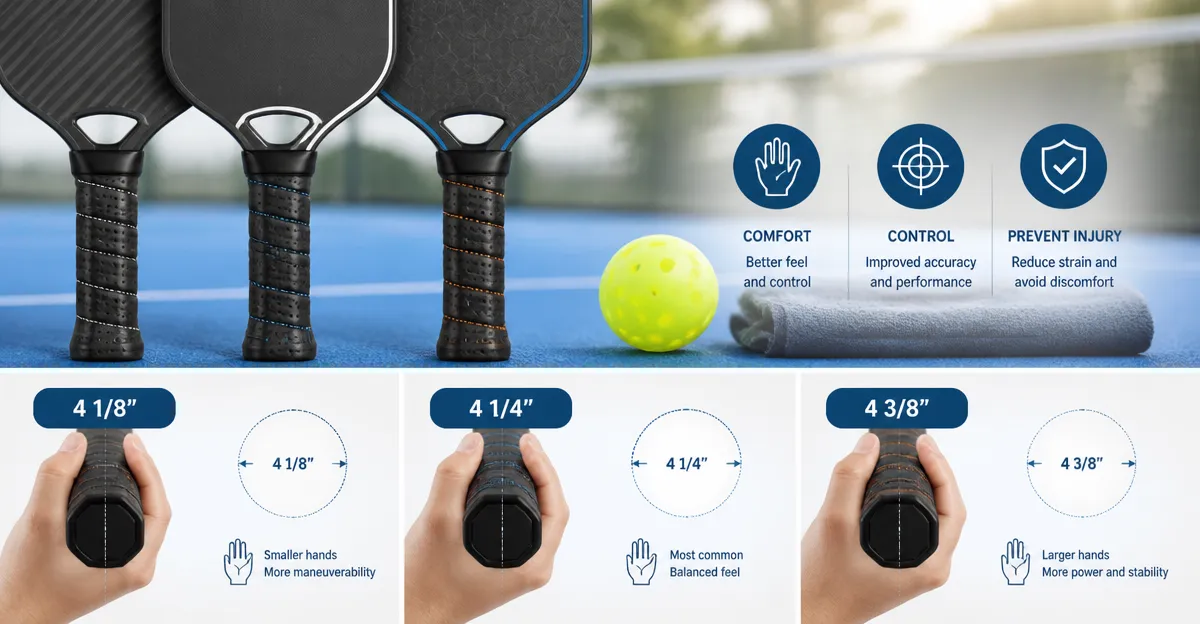
Choosing the correct paddle grip circumference is a fundamental decision for any pickleball player who wishes to maximise control, reduce fatigue, and prevent injury. This guide explains the three most common diameters—4 1/8, 4 1/4, and 4 3/8 inches—provides the biomechanical rationale behind each size, and recommends products that excel at each measurement. By the end of the article, readers will understand how to evaluate their hand dimensions, playing style, and comfort preferences, and they will have a clear plan for selecting and installing the ideal grip.
Background / Context
The grip circumference of a paddle directly influences the amount of force a player must exert to maintain a secure hold. A larger circumference distributes pressure across a broader area of the hand, reducing strain on the fingers and wrist, which is especially beneficial for players with tennis elbow or other repetitive‑stress injuries. Conversely, a smaller circumference allows for finer wrist articulation, enabling quicker adjustments for spin and rapid reaction shots. The three standard sizes—4 1/8, 4 1/4, and 4 3/8 inches—represent incremental changes of roughly 1 mm, yet each millimetre can alter the tactile feedback and overall comfort level.
Professional manufacturers employ ergonomic designs such as hexagonal patterns, finger‑groove channels, and gel‑infused materials to enhance grip efficiency. These technologies aim to increase the contact surface between hand and handle by up to 14 %, thereby reducing the effort required to hold the paddle firmly. Understanding these principles equips players to make an evidence‑based choice rather than relying on trial and error alone.
Understanding Grip Circumference
To determine which circumference best suits an individual, players should measure the distance around the palm just below the knuckles, excluding the thumb. A simple ruler or flexible tape measure yields an accurate reading. The following general guidelines apply:
- 4 1/8 inches – Ideal for players with smaller hands (typically women or youth) who prefer a tighter, more precise feel.
- 4 1/4 inches – The most common size, balancing control and comfort for a broad range of hand dimensions.
- 4 3/8 inches – Suited for larger hands or players who experience hand fatigue during long rallies; the larger diameter reduces grip pressure.
Beyond raw measurement, players must consider the grip’s material composition. Semi‑soft elastomers absorb sweat and vibration while providing sufficient friction, whereas gel‑based grips mould to the hand for a custom‑fit sensation. The choice of material can mitigate the disadvantages of a given circumference.
How Grip Size Affects Performance
When a player uses a grip that is too small, the fingers must wrap more tightly around the handle, increasing muscular tension and the likelihood of over‑gripping. Over‑gripping often leads to premature fatigue, reduced swing speed, and heightened risk of tennis elbow. Conversely, a grip that is too large forces the hand to open wider, decreasing the leverage for wrist snap and potentially compromising spin generation.
Research on ergonomic grip design demonstrates that a hexagonal pattern, such as that employed by Hesacore Pickleball Grip, expands the effective contact surface by up to 14 %. This design aligns naturally with finger joints, allowing players to maintain a secure hold with less muscular effort regardless of circumference. Similarly, the Hesacore Gel Grip uses a gelatinous material that conforms to the hand, providing a cushioning effect that is especially valuable for larger diameters where more surface area contacts the skin.
For players who prioritize tackiness and moisture management, overgrips such as the Professor P‑Tac Overgrip and the Srikel Overgrip add a thin, high‑tack layer that can be applied to any base grip, effectively fine‑tuning the overall circumference and sweat absorption.
Choosing the Right Grip Size
Below is a step‑by‑step process that integrates measurement, playing style, and product selection:
- Measure the palm circumference as described in the previous section.
- Match the measurement to the nearest standard size (4 1/8, 4 1/4, 4 3/8).
- Identify the primary concern: comfort (reduce fatigue), control (enhance spin), or injury prevention (dampen vibration).
- Select a base grip that aligns with the identified concern:
- For maximum comfort and vibration reduction on a 4 3/8″ handle, consider the Hesacore Gel Grip, which offers a soft, gel‑infused feel.
- For a balanced feel on a 4 1/4″ handle, the Hesacore Pickleball Grip provides medium softness and a patented hexagonal pattern.
- For players with smaller hands preferring a tighter feel on a 4 1/8″ handle, the Hesacore Elongated Grip (6″ length) can be trimmed to achieve the desired thickness while retaining the ergonomic benefits.
- Apply an overgrip if additional tackiness or sweat management is needed. The Professor P‑Tac Overgrip offers max tack and moisture‑wicking, while the Srikel Overgrip provides a soft‑touch, high‑tack surface at a lower price point.
When installing, always remove the factory grip, follow the manufacturer’s QR‑code video tutorial, and secure the grip with the provided plastic strips. Finish with an overgrip to lock the assembly and further improve sweat absorption.
Comparison / Selection Guide
| Feature | 4 1/8″ | 4 1/4″ | 4 3/8″ |
|---|---|---|---|
| Typical Hand Size | Small (women, youth) | Medium (average adult) | Large (men, players with larger palms) |
| Recommended Base Grip | Hesacore Elongated Grip (trimmed) | Hesacore Pickleball Grip | Hesacore Gel Grip |
| Key Material | Medium‑soft elastomer | Medium‑soft elastomer | Gel‑infused adaptive material |
| Vibration Dampening | High (hexagonal design) | High (hexagonal design) | Very high (gel cushioning) |
| Best Overgrip Pairing | Professor P‑Tac Overgrip | Professor P‑Tac Overgrip | Srikel Overgrip |
Best Practices & Tips
- Re‑measure your hand periodically; grip preferences can change as strength and flexibility evolve.
- When trimming a grip, remove no more than 0.5 in to preserve the hexagonal structure.
- Apply a thin overgrip after installing the base grip; this adds a protective layer and allows you to replace the overgrip more frequently without discarding the base grip.
- Use a hot‑water bath to soften semi‑soft grips before installation; this reduces the risk of tearing.
- Store paddles in a climate‑controlled environment to prevent the grip material from hardening or losing tackiness.
- For players prone to tennis elbow, prioritize grips with vibration‑dampening technology such as the hexagonal pattern or gel core.
Frequently Asked Questions
- 1. How do I know if my grip is too small or too large?
- If you feel excessive finger tension or notice frequent slipping when sweating, the grip is likely too small. If you experience a loose, wobbly feel or reduced wrist snap, it may be too large.
- 2. Can I change the circumference without buying a new grip?
- Yes. Adding a thin overgrip (e.g., Professor P‑Tac Overgrip) can increase diameter by roughly 0.1‑0.2 in. Conversely, removing an overgrip reduces it.
- 3. Does a larger grip always reduce fatigue?
- Generally, a larger diameter distributes pressure more evenly, which can reduce fatigue for players with larger hands. However, if the increase is excessive, control may suffer, leading to inefficient strokes that cause other forms of fatigue.
- 4. Are gel grips worth the extra cost?
- For players who experience significant vibration or have chronic elbow pain, the gel‑infused cushioning of the Hesacore Gel Grip provides measurable comfort benefits that justify the price premium.
- 5. How often should I replace my overgrip?
- Most overgrips maintain optimal tack for 4‑6 weeks of regular play. Replace them when the surface becomes smooth, loses moisture‑wicking ability, or shows visible wear.
- 6. Can I use an overgrip on a gel grip?
- Yes. Overgrips are designed to be compatible with any base grip, including gel models. This combination offers the gel’s cushioning plus the overgrip’s tackiness.
- 7. Does grip color affect performance?
- Color does not influence performance. However, brighter colors (e.g., the purple option of Professor P‑Tac Overgrip) can make wear easier to spot, prompting timely replacement.
Conclusion
Selecting the appropriate paddle grip circumference is a nuanced decision that blends anatomical measurement, material science, and personal playing style. By measuring the hand, understanding the trade‑offs of 4 1/8, 4 1/4, and 4 3/8 inches, and choosing a grip that incorporates ergonomic features such as hexagonal patterns or gel cushioning, players can minimise fatigue, enhance control, and protect against injury. The recommended products—Hesacore Pickleball Grip, Hesacore Gel Grip, Hesacore Elongated Grip, Professor P‑Tac Overgrip, and Srikel Overgrip provide reliable options for every circumference. Implement the best‑practice tips, revisit your grip periodically, and enjoy a more confident, comfortable game.
Products Featured in This Guide
Hesacore Pickleball Grip
Price: $22.86 | Rating: 4.5/5 (1,162 reviews)
Featured for its medium‑soft elastomer, patented hexagonal design, and excellent balance of comfort and control, making it ideal for the common 4 1/4″ circumference.
Professor P‑Tac Overgrip
Price: $11.04 | Rating: 4.5/5 (550 reviews)
Recommended for adding max tack and moisture‑wicking to any base grip, especially useful when fine‑tuning circumference or combating sweaty conditions.
Hesacore Gel Grip
Price: $23.72 | Rating: 4.4/5 (273 reviews)
Chosen for its softest gel material that molds to the hand, providing superior vibration dampening for larger 4 3/8″ grips.
Hesacore Elongated Grip
Price: $23.72 | Rating: 4.4/5 (242 reviews)
Provides a longer 6‑inch grip that can be trimmed for a precise 4 1/8″ or 4 1/4″ fit, featuring the same hexagonal efficiency as the standard model.
Srikel Overgrip
Price: $9.27 | Rating: 4.3/5 (251 reviews)
Offers an affordable, high‑tack, sweat‑wicking solution that works well with larger grips, extending performance without a large investment.